In Brief
- The Business Model Canvas gives farmers a one-page view of their entire business, enabling integrated decisions instead of addressing activities in isolation.
- The framework forces you to think beyond production and examine customers, value, costs, partnerships, resources, and revenue together.
- Many farming businesses struggle to scale because one part of the business grows faster than the rest. The Business Model Canvas helps identify these weaknesses before they become expensive mistakes.
Growth Is More Than Production
Agricultural growth is often equated with producing more: expanding hectares or increasing your livestock herd. Yet higher production does not automatically lead to more profit. Your revenue may rise while cash flow tightens, production may increase while margins stagnate, and new customers may add operational pressure. As a farm expands, these strains can expose weaknesses that were less visible at a smaller scale.
Why the Whole Business Must Scale Together
Your farm is more than a field production system. Its customers, resources, activities, partnerships, markets, costs, and revenue streams must work together. When one area grows faster than the others, pressure builds across the entire business. The Business Model Canvas is one of the most useful tool designed to reveal these gaps and help farmers align every part of the operation before they scale.
What Is the Business Model Canvas (BMC)?
The Business Model Canvas was developed by Alexander Osterwalder and introduced in his 2004 doctoral research on business model design. Since then, it has been adopted by entrepreneurs, investors, multinational companies, consultants, and business schools around the world as a practical way of understanding how a business works.
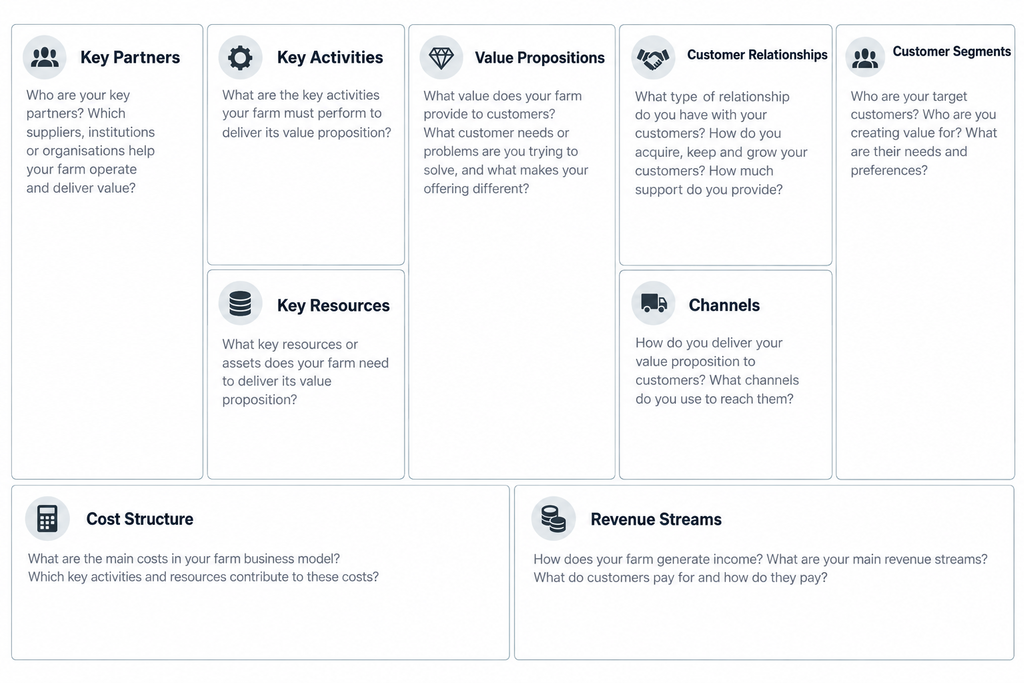
At its core, the Business Model Canvas is a strategic planning tool that condenses an entire business model into a single page. Rather than reading through a lengthy business plan, a business owner can look at the canvas and quickly understand how the business creates value, delivers value, and generates income. In many respects, the canvas functions as an executive summary of the business itself. As a farmer, this is particularly useful because agriculture naturally draws attention to operational issues. Running a farming business especially if you are still a small-scale, comes from you being a micro-manager of literally every key aspect of the business. In the middle of those daily demands, it is easy to lose sight of how the entire business fits together. The Business Model Canvas brings those moving parts together in a single framework.
The Customer Side: Who Are You Serving, and Why?
Farming itself still forms an integral part of our culture as African’s or just like in any other developing country, that does not automatically translate to that production should be the starting point in building your business case. The Business Model Canvas forces to think in terms of the customer or client first.
The framework starts by defining customer segments. In simple terms, who is your farming business trying to serve? If you are going to supply a supermarket, you are different from another farmer who is targeting to be supplying a processor, wholesaler, exporter, restaurant, or household consumer. Although the product may be similar, the customer’s expectations can differ dramatically.
Once you are clear about who your customer or customer are, then your next attention should now be on your value proposition. This is arguably the most important block within the entire canvas because it defines the value the business creates for its customers. Your value proposition is simply your product, commodity or service you seek to offer to your customers or clients. Think of it like in the case of fresh commodities like your tomatoes, customers rarely buy tomatoes because they are tomatoes. In as much as there may not be much product differentiation, customers often buy because consistency, freshness, quality, convenience, reliability, food safety, availability, or some combination of these factors. These are some of the factors which should form your value proposition as they make it easier to differentiate your business from other farmers.
The next consideration is customer relationships. Many farmers underestimate the role relationships play in business growth. This may also result from lack of exposure into the corporate world and poor leadership skills in as much as you may be on top of your game when it comes to the technical aspects of farming. You may be selling similar products targeting the same market as your neighboring farmer, but you can experience very different results depending on how they engage with customers. Some customers require regular communication, technical support, performance updates, or collaborative planning. Others prefer transactional relationships with minimal interaction. Understanding the type of relationship that supports the business model is often as important as understanding the product itself.
The final component on this side of the canvas is channels. Channels describe how value reaches the customer. This includes marketing, distribution, logistics, communication, and sales. You can sell directly from the farm gate, supplying retailers or export markets, these are all different channels you can use to reach your customer. As your businesses scale, the effectiveness of these channels often determines how efficiently value reaches customers and how easily the business can expand.
Together, these four building blocks answer key strategic questions: who is the customer, why do they buy from us, how do we maintain that relationship, and how do we reach them consistently?
The Operating Engine: How Will the Farm Deliver Value?
Once the customer side of the business is understood, the framework turns to the operational side. This is the part many farmers instinctively understand because it deals with the activities and resources that make production possible.
The starting point is key resources. These are the assets you require to operate the business and deliver the value promised to customers. It can include things like land, irrigation systems, machinery, livestock, storage facilities, and vehicles all qualify as resources. However, as your businesses grow, resources often extend beyond physical assets. You will need now to also put more value on technical expertise, management capability, access to finance, data, systems, and customer relationships, among other key success factors, as they can become equally important drivers of performance.
Next you now have to think about your key activities. These are the activities that allow your farming business to deliver its value proposition. In farming, production is an obvious example, but it is rarely the only one. Quality control, logistics, customer management, planning, record keeping, procurement, compliance, and performance monitoring can all become critical activities as the business expands. In fact, many scaling challenges originate not in production but in supporting activities that fail to keep pace with growth.
The third operational building block is key partners. No farming business operates entirely in isolation. Input suppliers, veterinarians, agronomists, financiers, transport providers, processors, distributors, and buyers all play roles in supporting the business. One of the most useful lessons from the canvas is that growth is often achieved through partnerships rather than ownership. Strong partners provide access to resources, capabilities, and efficiencies that may be difficult or expensive for the farmer to develop independently.
Taken together, resources, activities, and partnerships form the operating engine of the business. They determine whether the value promised to customers can actually be delivered.
The Financial Model: How Will the Business Make Money?
The final section of the canvas focuses on money. I guess money is the main reason why you are into business after all. I know as farmers we like to make a lot of noise claiming that we are contributing to food security and things like that, it is good as for it to be part of our mission, but if the business side of things is not working, your farm will not live long enough to see that mission being fulfilled.
Many aspiring commercial farmers and smallholder farmers have a reasonable understanding of production costs but a less appreciation of how costs and revenues interact across the entire business model. The Business Model Canvas addresses this through two final building blocks: cost structure and revenue streams.
Cost structure refers to the major costs required to operate the farm. These may include your typical seed, fertilizer, feed, labor, transport, fuel, machinery maintenance, packaging, compliance, and financing costs. The framework encourages business leaders to think beyond total expenditure and identify the major drivers of cost. This also helps to determine whether your business is prioritizing cost efficiency or investing heavily to deliver a differentiated value proposition.
Revenue streams describe the ways the business generates income. Depending on the level of diversification at your farm, revenue sources will be according to your number of enterprises. You may initially just start with one source of revenue, but the goal should be to scale up your business until you have multiple sources. For example, if you are a grain producer you may diversify into seed production, storage services, or processing. A livestock business may develop breeding stock, training services, manure sales, or contract grazing opportunities. Understanding how value ultimately translates into revenue helps reveal where future growth opportunities may exist.
The interaction between costs and revenue ultimately determines whether the business creates sustainable value or simply remains busy.
You can also read: How to Navigate Working Capital Gaps in Farming Ventures
Seeing the Whole Farm on One Canvas
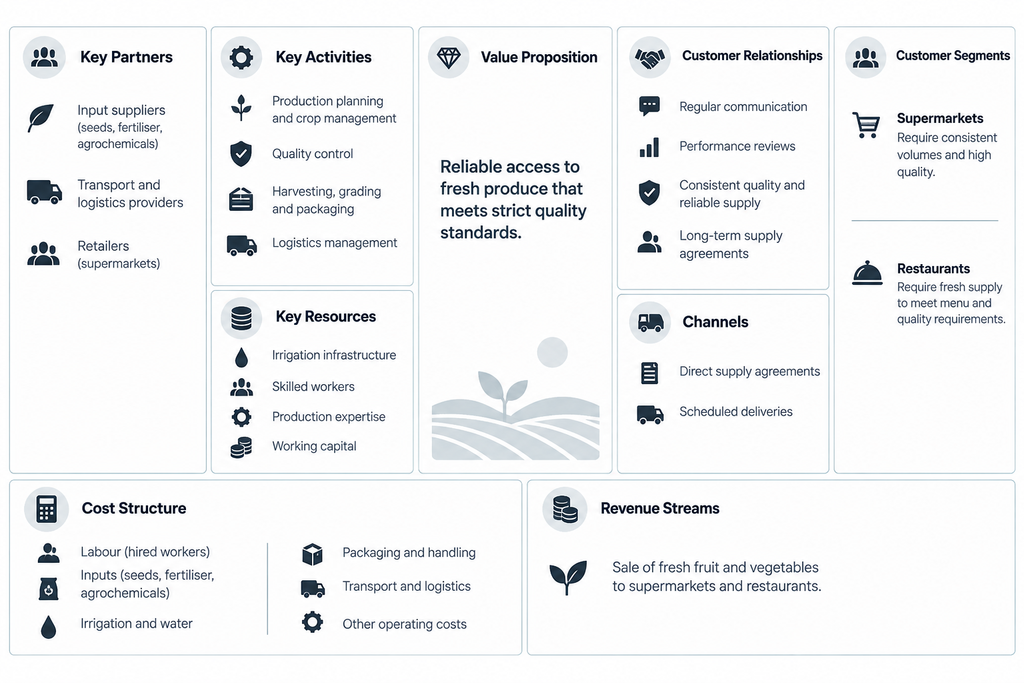
Now let’s imagine a fruit and veg farmer supplying supermarkets and restaurants. The customer segment is supermarkets and restaurants. The value proposition is reliable access to fresh produce that meets strict quality standards. Customer relationships are maintained through regular communication and performance reviews. Products reach buyers through direct supply agreements and scheduled deliveries.
To support this promise, the business requires irrigation infrastructure, skilled workers, production expertise, and working capital. It depends on activities such as production planning, quality control, harvesting, grading, packaging, and logistics management. Partnerships with input suppliers, transport providers, and retailers become critical. The business generates revenue through vegetable sales while managing costs associated with labor, packaging, irrigation, inputs, and transport.
If you are to look at this individually, these seem like separate business decisions. Viewed through the Business Model Canvas, they become part of one interconnected system.
Why Farmers Should Use the Canvas Before Scaling
The value of the Business Model Canvas lies not in the template itself, but in the strategic questions it prompts you to ask yourself as a farmer.
- Are we serving the right customers?
- Is our value proposition clear?
- Do we have the resources required to grow?
- Which activities create the most value?
- Are our partnerships helping us scale efficiently?
- Can our revenue streams support expansion?
- Are our costs aligned with the value we provide?
You already make decisions about these issues every day. The canvas just provides a structured way to see how those decisions connect. Production is rarely the only constraint on growth. Weaknesses elsewhere in the business model often create the real limits. Identifying those gaps before committing money can mean the difference between scaling profitably and merely becoming larger.
Related reading: 5 Things You Should Consider Before Starting a Farming Business
If you need more help in developing or refining your business model and turn it into a strategic tool you can use to scale your business, feel free to send me a message, you can also explore our services and see how we can be of help.
Conclusion
The Business Model Canvas is not a business-school exercise. It is a practical management tool that helps farmers or any business leaders to see their businesses as interconnected systems rather than isolated activities. By bringing customers, value propositions, relationships, channels, resources, activities, partnerships, costs, and revenues together on a single page, the framework provides a clearer view of how the business actually works.
For farmers looking to scale, that perspective is invaluable. Growth becomes less about producing more and more about building a business model capable of supporting profitable expansion. Once you can clearly see how the pieces fit together, decisions around investment, partnerships, markets, financing, and growth become easier to evaluate and, ultimately, easier to get right.